Insights
23/10/2026
International SEO for SaaS: 5 Mistakes to Avoid When Expanding into New Markets

Ryan McMillan


Expanding into a new market is one of the best milestones a SaaS team gets to celebrate. There’s a new customer base to win, and probably a new flag on the “where we operate” page.
From the dev side, the website part looks quick. You create a new locale, copy the pages across, swap the currency and go live.
International SEO for SaaS doesn’t work like a copy job, though. Google doesn’t see a new market. It sees the same page twice and picks one of them.
We’ve helped Australian and New Zealand tech companies take their sites into new countries. The ones that start ranking early treat each new market as an SEO project with its own international SEO strategy, and they get that work done before launch day.
Here are the five international SEO mistakes we see most often, and what to do instead.
This is the big one, and Google says it plainly:
“Localised versions of a page are only considered duplicates if the main content of the page remains untranslated.” (Google Search Central)
For English-speaking markets, that’s exactly the problem. Your NZ, AU and UK pages are all in English, so swapping “New Zealand” for “Australia” doesn’t make them different pages. Google’s canonicalisation docs name this case directly: region variants with “essentially the same content in the same language”.
When that happens, Google picks one URL to represent the group, and the others get crawled less often. The version Google keeps may not be the one you built for that market, which defeats the point of SEO for multiple countries.
Instead, treat every page you want to rank abroad as a new page for that market, with its own keywords, proof, examples and FAQs. Only then make it indexable.
The companies you compete with at home aren’t the ones you’ll meet abroad, and the keywords change too.
Buyers describe the same product in different words. An Australian workforce manager searches for rostering software, while their UK counterpart is more likely to look for a staff rota. A NZ payroll buyer cares about payday filing, and in Australia it’s Single Touch Payroll. Pages written in your home market’s vocabulary won’t match what local buyers type.
Before anyone rewrites a page, work out for each market:
Build one keyword set per country, not one per company. That’s what separates localising a page from copying it.
Your international website structure tells Google which page is meant for which country. Choosing it on purpose is far easier than unpicking it later.
Start with the URL structure. Most sites use one of these:
Then make your signals consistent. hreflang tells Google which version is for which market. Each localised page should list itself and its sister versions, and those versions should list it back. Canonical tags tell Google which URL is the main one, and a localised page should point to itself rather than to the home-market version.
Case studies need their own decision. They’re the one place you shouldn’t localise much, because the customer, the numbers and the quotes are facts. Keep them on every locale for your visitors, but give each one a home market. Point the other copies to that version with a canonical tag and leave them out of your hreflang set. Visitors everywhere still see the story, and Google has one clear version to rank.
Blogs sit somewhere in the middle. The core advice may hold everywhere, but the details that make a post useful are usually local.
Take a post on rostering for aged care. In Australia it needs to cover the SCHADS Award and the new Aged Care Act. New Zealand has different rules and regulators, so readers there ask different questions. It’s the same topic, but it needs two articles.
A few ways to make a blog belong to its market:
Not every post needs a version for every country. Sometimes one strong article in the market where it matters most is the better call. Make that a decision, though, rather than a side effect of copying the blog folder.
Leave SEO until after launch and the other four mistakes get much harder to fix.
Once pages are live and crawled, every change is a retrofit. Each page has to be rewritten, resubmitted and re-evaluated, and a busy team might manage a handful a month.
We’ve seen how slow that gets. One client launched four English-speaking markets on copied pages and could only localise a few pages each month. Things improved, but slowly. Over the last three months, around 85% of their clicks from those four markets still came from their home country.
A good international SEO strategy starts before the build. Sit down with your developers and SEO team, and agree on:
You don’t have to hold the whole launch until every blog post is ready. You do need to know which pages are meant to rank, and make sure those are ready first.
One of our clients, a New Zealand workforce management SaaS, launched an Australian subfolder in late April. Before go-live we worked alongside their developer to agree which pages Google should index, and we rewrote the homepage and main industry pages for Australia first. That covered Australian keywords and competitors, local compliance such as the SCHADS Award and the new Aged Care Act, Australian sources and Australian blog content.
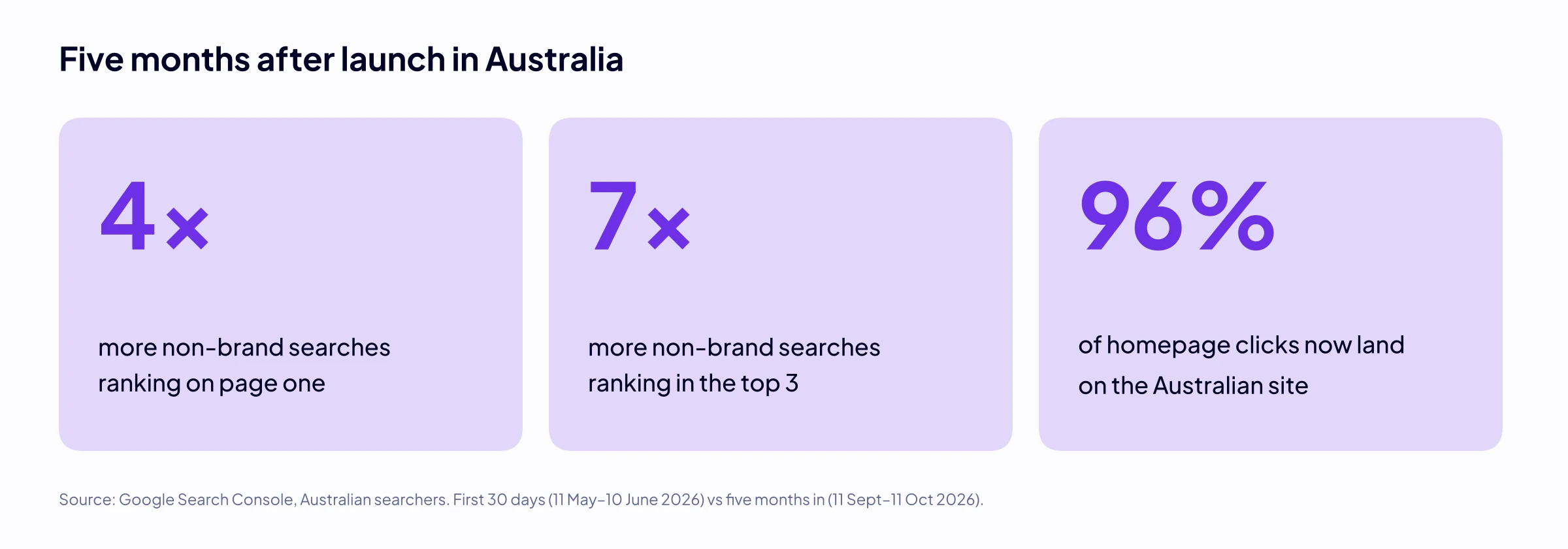
Australians searching for the brand now land on the Australian site. The site also ranks on page one for four times as many local non-brand searches, including “aged care time and attendance software” and “aged care workforce management”.
Source: Google Search Console, Australian searchers only. First 30 days is 11 May to 10 June 2026; five months in is 11 September to 11 October 2026.
AI search doesn’t need a separate plan. The work above already covers it.
Google says there’s no special trick for appearing in AI Overviews or AI Mode. To show up as a supporting link, a page must be “indexed and eligible to be shown in Google Search with a snippet”, and “there are no additional technical requirements”.
If Google folds your Australian page into your New Zealand one, the Australian page can’t appear in Australian AI answers either. And when a buyer asks an assistant for “rostering software for aged care in Australia”, a page written around Australian rules, customers and sources is the better answer.
In Google’s words, “all existing SEO fundamentals continue to be worthwhile”.
These are the best practices in the order we’d tackle them before a new locale goes live:
International SEO is easiest to get right before the first page goes live, but it’s never too late to fix. We work with your dev team to plan each new market, from the URL structure and hreflang to the technical SEO, market-specific content and AI optimisation each locale needs to rank.
Let’s talk about where you’re heading next.

International SEO for SaaS means setting up your website so each country you sell into has pages Google can index and rank for local buyers. The technical side is your URL structure plus hreflang and canonical tags. The content side is pages written around each market’s keywords, competitors and regulations.
Give each country its own localised version of your priority pages, based on that market’s keyword and competitor research. Use hreflang so Google knows which version is for which country, and make sure each version is indexable. Copied pages in the same language tend to be treated as duplicates, so only one of them ranks.
Subfolders such as /au/ or /uk/ suit most SaaS companies, because every market shares one domain’s authority and the site is easier to manage. Country domains send a strong local signal, but each one builds authority on its own and costs more to run.
No. hreflang tells Google which version to show in which country, but it doesn’t make near-identical pages unique. Google says localised versions only count as duplicates when the main content is untranslated. For English-speaking markets, that means the content itself has to differ.
Atlas Digital is an Australia-based, fully remote marketing agency for tech companies. We run paid media, SEO, content, GEO and conversion rate optimisation for SaaS and tech businesses across Australia, New Zealand and the US.