Insights
23/10/2026
International SEO for NZ SaaS: 5 Mistakes to Avoid When Expanding Overseas

Ryan McMillan

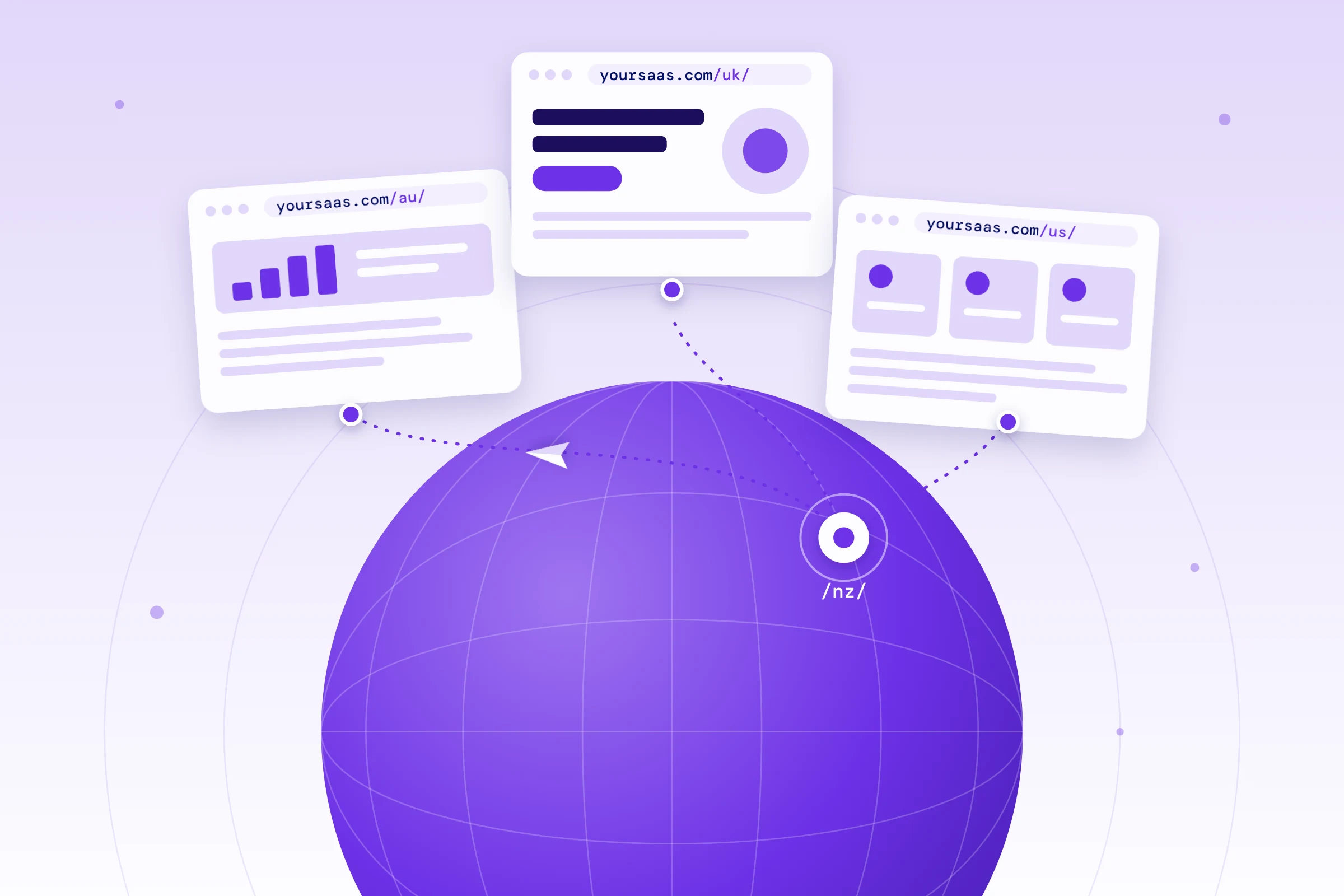
For most Kiwi SaaS companies, home gets small quickly. With around five million people in New Zealand, the next growth step is usually offshore, and Australia tends to come first, followed by the UK or the US.
On the website, that step can look like a quick job for the dev team. Add an /au/ folder, duplicate the NZ pages, switch NZD to AUD and launch.
Search engines don’t treat it that way. Google doesn’t see a Kiwi company arriving in a new market. It sees two near-identical pages and chooses one to show.
We’ve helped New Zealand and Australian tech companies take their websites into new countries. The ones that rank early run each new market as its own SEO project, with its own international SEO strategy, and they do most of that work before launch.
These are the five international SEO mistakes we see most often when NZ SaaS companies expand, and how to avoid them.
Google is clear about when localised pages count as duplicates:
“Localised versions of a page are only considered duplicates if the main content of the page remains untranslated.” (Google Search Central)
That’s the catch for a New Zealand company. Your NZ, Australian and UK pages are all in English, so there’s nothing to translate. Changing “Kiwi businesses” to “Aussie businesses” doesn’t create a new page. Google’s canonicalisation guidance describes this exact situation: regional versions with “essentially the same content in the same language”.
Google then groups those pages, picks one URL to represent them and crawls the rest less often. Often the URL it keeps is your original NZ page, which means your Australian page never gets a chance to rank in Australia.
The fix is to treat each page you want to rank overseas as a new page for that market, with local keywords, local proof, local examples and local FAQs. Make it indexable once that work is done, not before.
Australia looks close to home, and that’s what makes it easy to underestimate. The competitors are different, the regulations are different and the search terms often are too.
A NZ payroll buyer cares about payday filing with Inland Revenue, while an Australian buyer is looking for Single Touch Payroll compliance with the ATO. GST is 15% in New Zealand and 10% in Australia. Workforce software in Australia has to speak to modern awards and Fair Work, where a Kiwi buyer thinks about the Holidays Act. In the UK, the same buyer may search for a staff rota rather than rostering software.
Before rewriting a single page, research each new market:
Build a keyword set for every country you enter. Your NZ keyword list is a starting point, not the plan.
Your international website structure is how Google works out which page belongs to which country. It’s much easier to choose it deliberately than to change it after launch.
Many Kiwi SaaS companies start on a .co.nz domain. Before expanding, decide whether you’ll keep it for New Zealand and add new domains, or move to a .com with a folder for each country. Moving domains is a migration with its own risks, so plan it with your developers and SEO team, rather than doing it alongside a launch.
These are the three common set-ups:
Whichever you choose, keep your signals consistent. hreflang tells Google which version is meant for which country. Every localised page should reference itself and each of its alternate versions, and those versions should reference it back. Canonical tags tell Google which URL is the main one, so a localised page should point to itself, not back to the NZ original.
Case studies are the exception to localising everything. The customer, the results and the quotes are facts, so there’s little to adapt. Show them in every market for visitors, but choose one home market for each case study. Canonicalise the other copies to that version and leave them out of your hreflang set, so Google has one clear page to rank.
Blog content falls somewhere in between. The main advice might apply everywhere, but the detail that makes a post useful usually depends on the country.
Take an article about rostering in aged care. A Kiwi version needs New Zealand employment rules, local sources and NZ providers as examples. An Australian version has to cover the SCHADS Award and the new Aged Care Act. The topic is the same, but the readers need two different articles.
Ways to make a blog post belong to its market:
You don’t need a version of every post for every country. Sometimes one strong article for the market where the topic matters most is the better choice. Just make it a deliberate choice, not the result of copying the whole blog across.
If SEO waits until after launch, the other four mistakes become slow and expensive to fix.
Once pages are live and crawled, every improvement is a retrofit. Each page needs rewriting, resubmitting and re-evaluating, and most busy teams can only get through a few a month.
We’ve watched how long that takes. One client launched four English-speaking markets on copied pages and could only localise a few pages a month. Results improved, but slowly. Over the last three months, about 85% of their clicks from those four markets still came from their home country.
Good international SEO starts before the build. Get your developers and SEO team together and agree:
You don’t need to delay launch until every blog post is localised. You do need to know which pages are meant to rank, and have those ready first.
One of our clients, a New Zealand workforce management SaaS, launched an Australian subfolder in late April. Before go-live we worked with their developer to agree which pages Google should index, and we rewrote the homepage and key industry pages for Australia first. That meant Australian keywords and competitors, local compliance such as the SCHADS Award and the new Aged Care Act, Australian sources and Australian blog content.
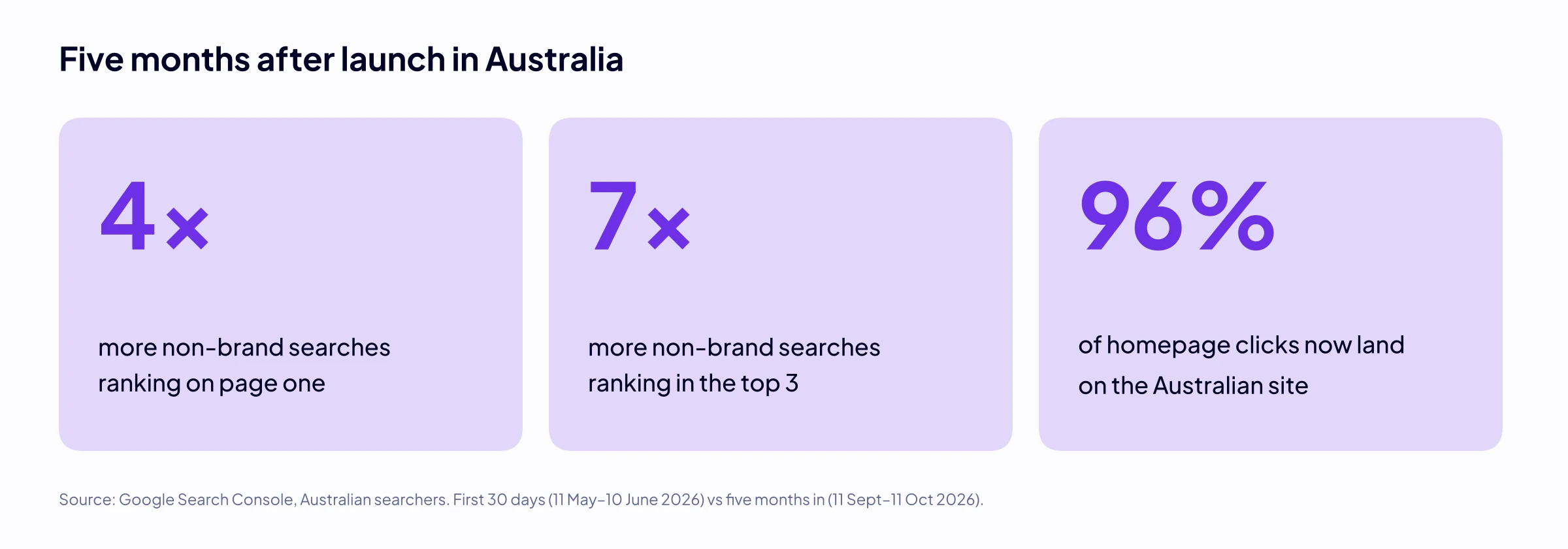
Australian searchers looking for the brand now land on the Australian site rather than the NZ one. The site also ranks on page one for four times as many Australian non-brand searches, including “aged care time and attendance software” and “aged care workforce management”.
You don’t need a separate plan for AI search. Getting the steps above right covers it.
Google says there’s nothing extra to do to appear in AI Overviews or AI Mode. To be shown as a supporting link, a page has to be “indexed and eligible to be shown in Google Search with a snippet”, and “there are no additional technical requirements”.
So if Google merges your Australian page into your NZ page, the Australian version can’t appear in Australian AI answers. And when an Australian buyer asks an assistant for “payroll software with Single Touch Payroll”, a page written around Australian rules, customers and sources is the one worth citing.
As Google puts it, “all existing SEO fundamentals continue to be worthwhile”.
Work through these before a new market goes live:
International SEO is easiest to get right before the first page goes live, but it’s never too late to fix. We work with your dev team to plan each new market, from the URL structure and hreflang to the technical SEO, market-specific content and AI optimisation each locale needs to rank.

For most NZ SaaS companies, a .com with a subfolder for each country (such as /nz/ and /au/) is the simplest way to grow, because every market shares one domain’s authority. A .co.nz is a strong local signal at home, but each new country domain has to build its authority from scratch. If you’re moving from .co.nz to .com, plan it as a migration before you launch new markets.
Give Australia its own versions of your priority pages, based on Australian keyword and competitor research and covering local requirements such as Single Touch Payroll or modern awards where they apply. Add hreflang between the NZ and Australian versions, canonicalise each page to itself, and make sure the Australian pages are indexable.
Yes, for the pages you want to rank in both countries. Google treats same-language regional pages with essentially the same content as duplicates and shows only one of them. Each version needs content written for that market, not just a swapped country name or currency.
Only partly. hreflang tells Google which version to show in which country, but it doesn’t make near-identical pages unique. If the NZ and Australian pages say the same thing, Google may still fold them together, so the content itself has to differ.
Atlas Digital is a New Zealand-based, fully remote marketing agency for tech companies. We run paid media, SEO, content, GEO and conversion rate optimisation for SaaS and tech businesses across New Zealand, Australia and the US.