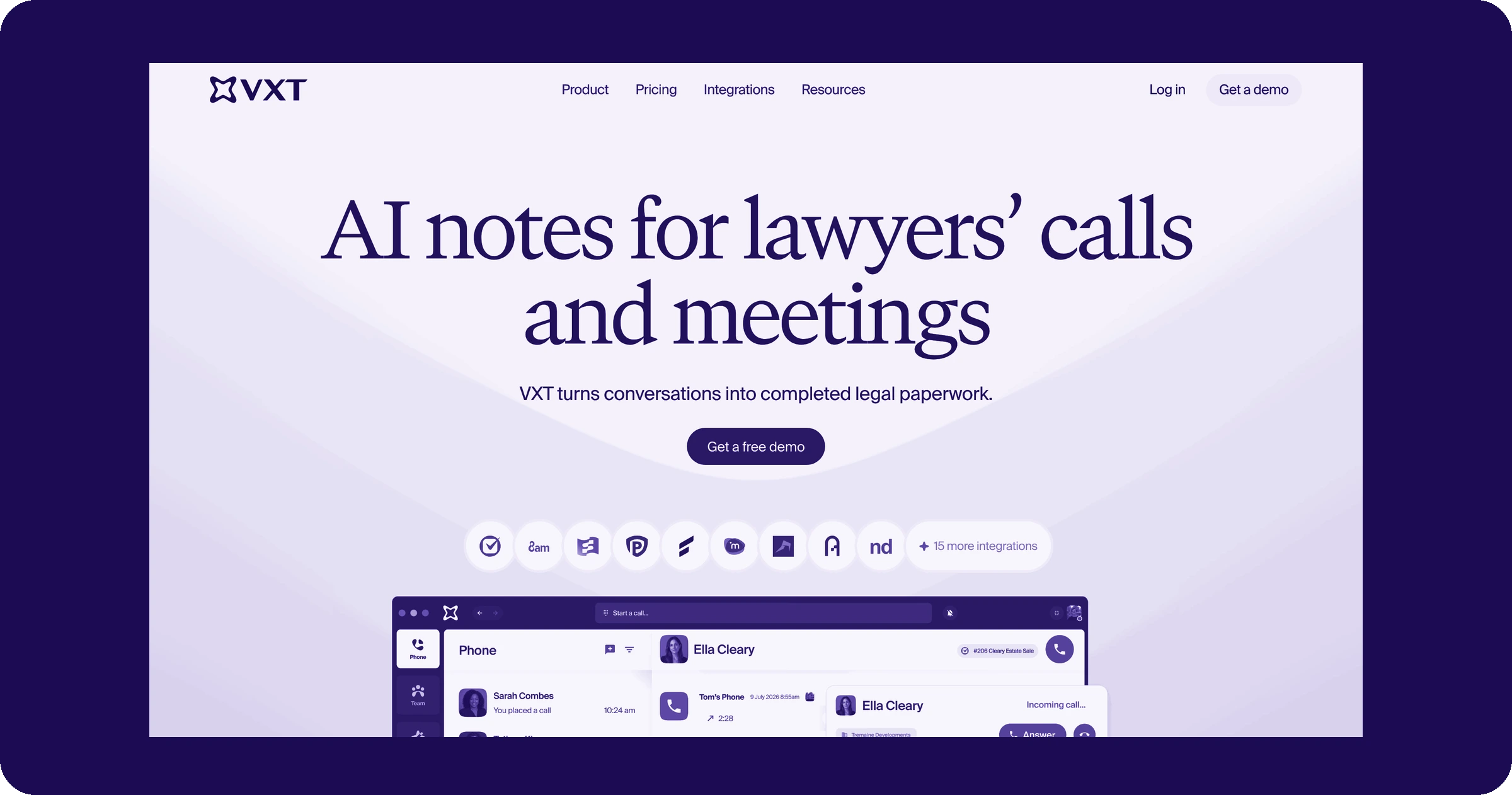
VXT is an AI notetaker and phone system for lawyers. During calls and meetings, VXT takes notes for lawyers, then summarises and saves those notes into their legal software, even drafting follow-up emails based on client or team conversations. Their mission is to transition the legal world to a place where administrative work is a distant memory, so lawyers can focus on their practice, not paperwork.
VXT was investing in paid and organic traffic to its website, but had no structured way to test whether its home, sales contact and law industry pages were converting that traffic as well as they could. This is where Atlas came in. From October 2025, we ran a hypothesis-led CRO testing programme across VXT's highest-traffic pages, built to find real, statistically defensible wins and, just as importantly, to catch changes that looked good on paper but would have quietly cost VXT booked demos.
Every additional customer VXT wins from its existing traffic is a customer it didn't have to pay extra in ad spend or content investment to acquire, so conversion rate has an outsized effect on the overall cost of growth. But without structured testing, VXT had no evidence-based view of which pages, messaging or UX decisions were actually costing them booked demos, and no rigorous way to tell a real signal apart from noise when an early test result looked promising.
However, buyers looking at the general home page, prospects on the contact page ready to book, and law firms evaluating VXT's law industry page all behave differently. VXT's audience mix meant a change that helped one page could easily hurt another.
We built VXT's CRO programme in three stages.
We started with a full analysis of user journeys on the VXT website, presenting our findings in workshop format with input from the VXT team. Our analysis mapped user flows and mini-funnels across the home, sales contact and law pages, then built an ICE-scored roadmap so every planned test was prioritised by expected impact and ease of implementation.
Every A/B test ran in VWO to a 100-conversion significance threshold before being called. On top of that, we aimed for 75–80% on the "Probability to be better" metric. No test was declared a winner or loser on a promising early trend. That discipline caught false positives directly: an early homepage headline test (HM-01) looked like a small winner at 15–16 conversions per variant, then reversed to a clear loser (−12.35% / −9.12% on Calendar bookings) once re-run at four times the sample size. In a separate test, a concerning drop in bookings was traced back to a calendar-availability mismatch between page variants rather than the page copy itself. We caught and fixed this glitch before drawing the wrong conclusion.
Of the seven tests run, two produced statistically significant deployed winners and four were correctly rejected before shipping. Each rejected test is documented with the same rigour as the wins, because a "don't ship" call on a change that would have cost VXT bookings is just as valuable as a change that grows them.


Between October 2025 and May 2026, VXT ran seven structured, hypothesis-led tests across its home, sales contact and law pages. Two produced statistically significant winners, both deployed to 100% of traffic.
All seven CRO tests run for VXT between October 2025 and May 2026, from Atlas's final CRO report.
Before Atlas: VXT was driving paid, organic and direct traffic to its Home, Sales Contact and Law pages with no structured way to test whether page content and layout were converting that traffic as well as they could.
After Atlas: VXT has a validated, ICE-scored testing roadmap, two deployed page changes with a combined $385K in projected annual revenue impact, and four documented "don't ship" decisions that protected its conversion rate on its highest-traffic pages.
Holding every test to a fixed 100-conversion threshold rather than calling it on an early trend is what caught the HM-01 headline test reversing from a small apparent win to a clear loss once the sample size grew. That discipline is what makes the two winning results, and the four rejected ones, defensible.
Both winning tests worked by giving visitors an extra, low-commitment way to engage, using an interactive product demo and an on-demand video offer, rather than removing steps from the page. That is a useful pattern in its own right: on VXT's site, adding a qualifying interaction consistently outperformed simplifying the path.
Three of the four rejected tests failed for a shared, instructive reason: they removed friction that was doing real work. A simplified mobile form, an added navigation menu and a shorter landing page all looked like obvious UX improvements and all reduced Calendar bookings, because the friction they removed had been filtering for genuinely interested visitors. Documenting that pattern is now part of VXT's institutional knowledge for future page changes.
Let's talk about how a structured, evidence-first CRO programme can turn your existing traffic into more booked demos without spending another dollar to drive new visitors.